CGT receipts up 69% this January – how could you cut your bill?

Don't invest unless you’re prepared to lose all the money you invest. This is a high-risk investment and you are unlikely to be protected if something goes wrong. Take 2 mins to learn more.
Estimated reading time: 2 min
Due to the potential for losses, the Financial Conduct Authority (FCA) considers this investment to be high risk.
What are the key risks?
If you are interested in learning more about how to protect yourself, visit the FCA’s website here.
The Treasury has just recorded a budget surplus of £30.4 billion, the largest since record begun. A major contributing factor was the surge in capital gains tax (CGT) receipts.
This January, HMRC received £17 billion in CGT, up from £10 billion last January, a 69% increase, as allowance cuts and higher rates started to bite.
The main CGT rates were increased from 10% (basic-rate taxpayers) and 20% (higher and top-rate taxpayers) to 18% and 24% respectively in October 2024, while the annual exempt amount had already been cut to £3,000. Frozen thresholds have further widened the net.
If you paid or are due to pay a CGT bill – and are comfortable with the higher risks of investing in young UK companies – there are ways you could still mitigate it.
Both the EIS (Enterprise Investment Scheme) and the SEIS (Seed Enterprise Investment Scheme) offer CGT relief, allowing you to claim relief on gains made before or sometimes even after your EIS or SEIS investment.
How does EIS and SEIS CGT relief work? How could experienced investors benefit? What are the risks to consider? Below we explain the main facts.
This is only a very quick summary – not personal advice. You should consider your options carefully, including risks, before investing to form your own view. You should not make investment decisions based on the tax benefits and possible rule changes alone. Tax rules can change and benefits depend on circumstances.
Important: The information on this website is for experienced investors. It is not a personal recommendation to invest. If you’re unsure, please seek advice. These investments are for the long term. They are high risk and can fall as well as rise in value: you could lose all the money you invest.
If you already have realised a chargeable gain – or are planning to do so – there are ways to potentially mitigate your CGT liabilities.
CGT relief is available when you invest in ambitious, early-stage – and hence high risk – British businesses under the Enterprise and Seed Enterprise Investment Schemes (EIS and SEIS).
Investing a gain under EIS could allow you to defer that gain until the EIS investment itself is realised, while SEIS could provide relief of up to 50% on a CGT bill. In both cases, in addition, any gains should be tax free.
You can invest up to £1 million under EIS (or up to £2 million if at least £1 million is invested in knowledge-intensive companies), and up to £200,000 under SEIS, tax-efficiently each tax year.
Investing a gain in EIS can allow you to defer the CGT liability until the EIS shares are disposed of.
For example, if you realise a £100,000 taxable gain, you would normally face a £24,000 CGT bill. However, by investing that £100,000 into an EIS, you could defer the £24,000 CGT liability and also claim up to £30,000 in income tax relief. As a result, rather than paying £54,000 in taxes upfront, you would instead have £100,000 working for you.
To qualify for deferral relief, the reinvestment into EIS must be made at least 12 months prior to, or three years after, the original gain was made. This is just a short summary – other rules and restrictions may apply.
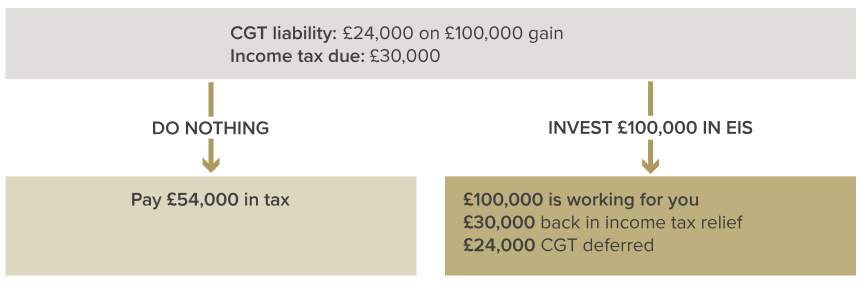 |
For illustrative purposes only. Assumes you are a higher or additional-rate taxpayer and have already used your CGT-free allowance.
Alongside the considerable risks of investing in small, young companies, there are two key points to remember when deferring a gain.
First, you are deferring the gain, not eliminating it. When the EIS investment is realised, the CGT bill becomes payable, even if the investment is sold at a loss or has failed. One mitigating factor is that EIS loss relief may allow you to offset losses against either your CGT or income tax bill.
Second, when the CGT becomes payable, it will be charged at the prevailing rate at that time, which could be higher or lower than when the EIS investment was made. Remember, tax rules can and do change and the value of benefits will depend on individual circumstances.
When you invest in SEIS, giving you exposure to the youngest and thus highest risk companies, you may be able to cut your CGT liability in half (this is called Reinvestment Relief).
Imagine you have a £100,000 taxable gain (£24,000 CGT liability) and a £50,000 income tax bill.
If you invest £100,000 in SEIS, you could claim up to £50,000 back in income tax and £12,000 (half of £24,000) in CGT.
This means instead of paying a total tax bill of £74,000, you have £100,000 working for you.
Moreover, that £100,000 SEIS investment could effectively cost you as little as £38,000, once you take the tax reliefs into account.
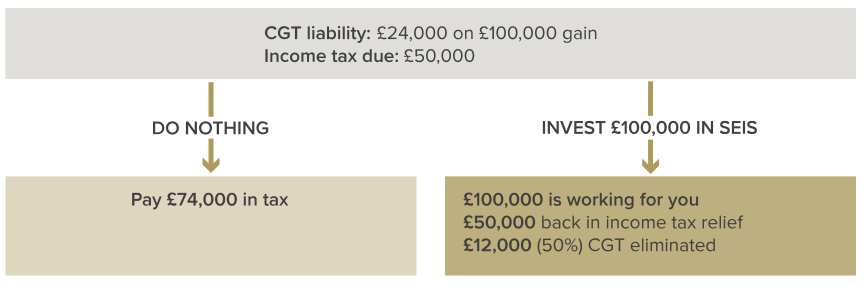 |
For illustrative purposes only. Assumes you are a higher or additional-rate taxpayer and have already used your CGT-free allowance.
Alongside the considerable risks of investing in small, young companies, please remember that to claim Reinvestment Relief you must have also claimed the income tax relief in the same tax year. So, in the above example, to claim full relief on the £24,000 CGT bill, you would first have to claim the £50,000 income tax relief in the same tax year. The maximum you can invest in SEIS with tax relief is currently £200,000.
Wealth Club aims to make it easier for experienced investors to find information on – and apply for – investments. You should base your investment decision on the offer documents and ensure you have read and fully understand them before investing. The information on this webpage is a marketing communication. It is not advice or a personal or research recommendation to buy, sell or hold any of the investments mentioned, nor does it include any opinion as to the present or future value or price of these investments. It does not satisfy legal requirements promoting investment research independence and is thus not subject to prohibitions on dealing ahead of its dissemination.
Alex Davies
Chief Executive
Alex was a board director at Hargreaves Lansdown, where he worked for 15 years. He was responsible for building Hargreaves Lansdown into the biggest direct-to-consumer SIPP provider in the UK with more than 150,000 clients and over £12 billion under management. He is a keen investor with a portfolio of shares, funds, student property, EIS and VCT investments.