How Private Equity is reshaping portfolios and the playing field

Important: The information on this website is for experienced investors. It is not a personal recommendation to invest. If you’re unsure, please seek advice. Investments are for the long term. They are high risk and illiquid and can fall as well as rise in value: you could lose all the money you invest.
The worlds of sport and finance have long operated on opposing ends of a cultural, ideological, and most importantly, incentive spectrum.
Sports teams were community organisations, with ownership driven by personal pride or a sense of civic duty. Steadfastly enthusiastic fan bases were deliberately under-monetised, yet even the largest teams began to suffer from persistent funding gaps. This soon created a damaging cycle as more teams teetered on the brink of collapse, leagues were left in disarray as numbers shrank, and ultimately, the fans became disinterested as the fate of the sport they loved grew uncertain.
Despite the challenges, a new cohort of investors has descended upon the major sporting leagues with a radically new investment thesis.
For Private Equity firms, sport is no longer viewed merely as a depreciating passion project, but rather an opportunity to unlock an undervalued asset class with stable broadcast revenues and global brand awareness.
These characteristics, also found in other forms of alternative investment, could play a valuable role in helping firms diversify their broader investment portfolio. Acting as a vehicle for long-term value creation that is typically more stable and less correlated than public markets. Consequently, Private Equity, once the preserve of high-finance professionals, has entered the lexicon of sports fanatics as a growing number of leading franchises embrace these new sources of funding.
Source: Deloitte Football Money League, Jan 2026.
In football alone, this form of financing has made considerable inroads. Over a third of members in Europe’s ‘Big Five’ leagues have a form of private market funding, with the majority of English Premier League clubs receiving Private Equity or Private Debt financing. Notable deals include the 2022 acquisition of Chelsea FC by a Clearlake Capital led consortium, marking one of the largest transactions in the sport. Similarly, Italian football rivals, AC Milan and Inter Milan, were both separately acquired by US investment firms – Redbird Capital and Oaktree Capital, respectively.
As investor interest in this sector continues to grow, competition for the best deals has driven Private Equity firms to explore previously untapped areas of the market. For instance, rugby’s history of financial difficulties presented a rare opportunity for CVC Capital Partners to consolidate an often-overlooked sport. Following a successful stint in motorsport, first with Moto GP and culminating with the acquisition and subsequent sale of its controlling interest in Formula One, the firm was keen to identify another sport with as yet untapped commercial appeal.
CVC has subsequently invested more than £700 million into professional rugby, aiming to bring together multiple leagues (Six Nations, Premiership Rugby, and United Rugby Championship) under a single venture to better capture commercial opportunities.
Source: DBS CIO Insights 2024/2025 – Sports as an Asset Class. S&P Global, Forbes franchise valuations, Sportico. Returns based on valuations rather than realised cash returns; growth shown as the annualised change in value between the start and end of the period.
In the US, the most significant watershed moment occurred when the National Football League (NFL) finally opened its doors to private investment in 2024, having been the last holdout amongst the five major sports leagues. This change granted private equity firms the ability to own minority stakes of up to 10% in league franchises, encouraging sports-focused investment firms to build multi-team portfolios. A decision that followed in the footsteps of other major leagues, such as the NBA, where close to two-thirds of its teams are entering the 2026 season receiving Private Equity backing, pushing franchise valuations to record levels.
The opportunity set has motivated a number of the leading investment firms to create dedicated divisions, with CVC Capital, Apollo Global Management and Ares Management among others launching vehicles to capitalise on the sporting sector.
Interested? Get your free guide: Investing in Private Equity and Private MarketsDownload your free guide to read the main facts about Private Equity and Private Markets, including performance, risks and how to invest. |
 |
Yet this explosion in private market funding is far from contained to the world of sport. Globally, Private Equity investment rose from $1.8 trillion in 2024 to a four-year high of $2.1 trillion in 2025.
This growth has been supported by a broader trend in private companies taking longer to go public, with the median age now sitting at close to 11 years.
There are roughly 25 times the number of actively held and privately funded companies as contained within the public market. Yet the total capitalisation of these Private Equity and Venture Capital-backed companies is just 12% of the public markets, driven by many years of these investments being restricted to only institutions and accredited investors.
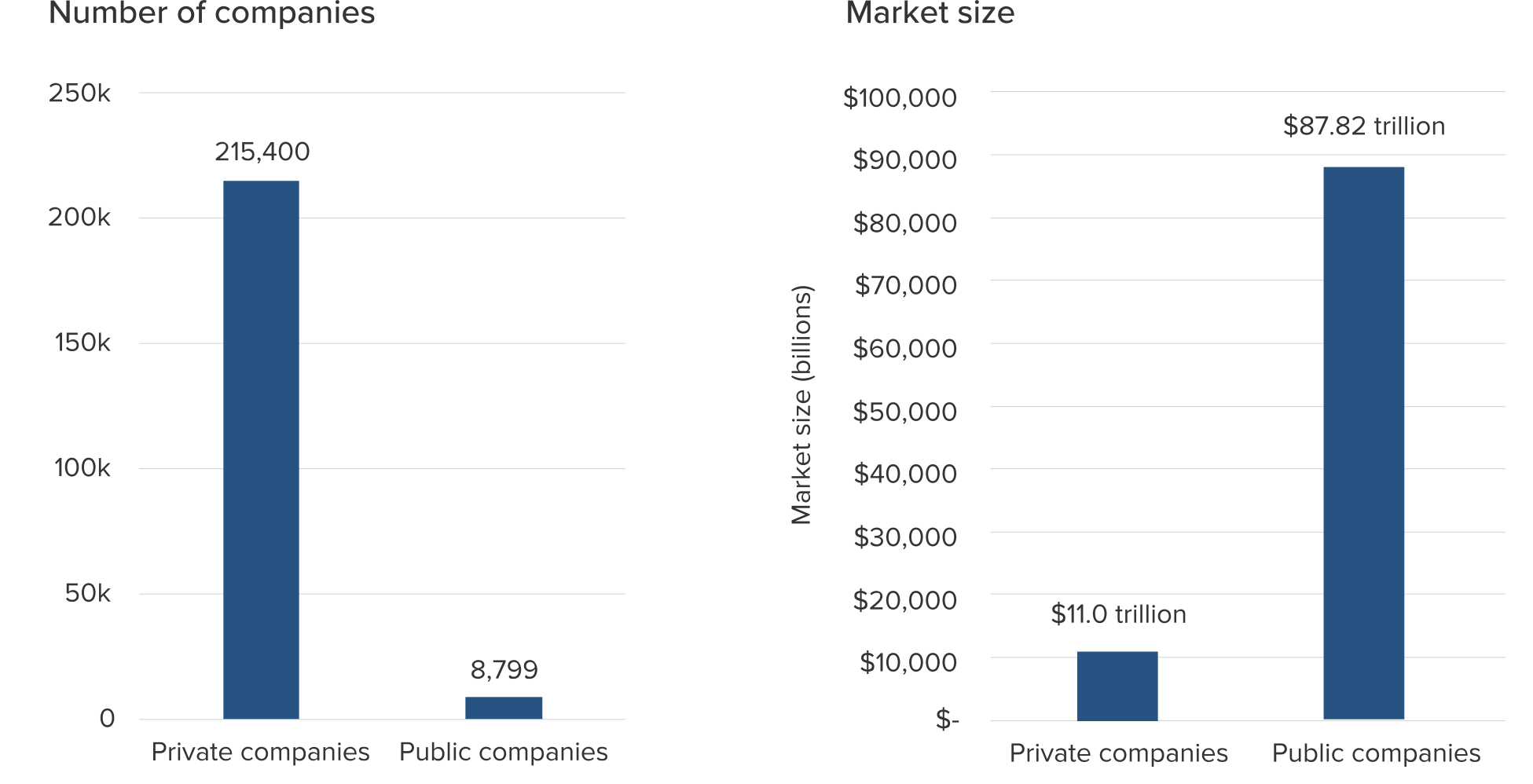
Therefore, the rise of Private Equity within sport can be seen as a leading indicator. The start of a growing trend of keeping value creation within the private sphere, resulting in some of the highest growth and most innovative companies remaining firmly out of public reach.
But times are changing, and private no longer means inaccessible. For experienced investors, the launch of semi-liquid funds has facilitated an easier and more flexible way to reach companies not traded on a public exchange. These instruments can help sophisticated private investors diversify their portfolio away from purely public market equities, benefiting from the potential for superior uncorrelated returns.
For eligible investors, those who can self-certify as sophisticated or high net worth, the Private Markets service from Wealth Club provides access to a range of Private Equity funds, amongst other Private Credit, Secondaries, and Infrastructure vehicles. This service facilitates access to funds from leading private market managers starting froma minimum £10,000 investment, and each is reviewed by our in-house research team. These funds provide Private Equity exposure with more frequent redemption windows than traditional private equity funds with capital paid in full upfront, to be deployed at specified dealing points, avoiding complicated drawdown structures and fixed-term investments.
However, these investments are still long-term commitments and it could take years to generate a return, if at all, and you should only consider investing capital that is not needed for several years. They are also high-risk investments with a complex structure, so you could lose some or all of the money you invest. Additionally, despite being semi-liquid, Private Equity investments are not easily realisable, and early redemptions can incur penalties. There is also an innate valuation risk as these investments are vulnerable to greater levels of pricing uncertainty compared to publicly traded alternatives.
Wealth Club aims to make it easier for experienced investors to find information on – and apply for – investments. You should base your investment decision on the offer documents and ensure you have read and fully understand them before investing. The information on this webpage is a marketing communication. It is not advice or a personal or research recommendation to buy, sell or hold any of the investments mentioned, nor does it include any opinion as to the present or future value or price of these investments. It does not satisfy legal requirements promoting investment research independence and is thus not subject to prohibitions on dealing ahead of its dissemination.
Alex Davies
Chief Executive
Alex was a board director at Hargreaves Lansdown, where he worked for 15 years. He was responsible for building Hargreaves Lansdown into the biggest direct-to-consumer SIPP provider in the UK with more than 150,000 clients and over £12 billion under management. He is a keen investor with a portfolio of shares, funds, student property, EIS and VCT investments.