Anthropic and other AI IPOs: three Private Markets funds for pre-IPO access to some of AI’s biggest names

Anthropic, the developer behind AI assistant Claude, is reportedly preparing for a stock market listing ahead of US Thanksgiving on 26 November 2026.
Reportedly, the company could be valued at as much as $2 trillion.
If confirmed, such a valuation would see Anthropic overtake SpaceX, which floated in June at a valuation of $1.77 trillion, as the largest IPO in history. It would also mean this five-year-old company, with around 6,000 employees, would be worth more than the combined value of Britain’s 15 largest listed companies, which employ 1.2 million people between them.
Anthropic’s plans come after rival OpenAI – the creator of ChatGPT – abandoned expectations of a 2026 stock market debut, seeking instead to raise at least $30 billion privately at a valuation of potentially $1.4 trillion. If this completes, it will be a 64% increase on OpenAI’s valuation at its previous funding round ($852 billion valuation in March 2026).
For investors, these potential IPOs offer a reminder that some of the most influential companies in AI remain inaccessible through public markets during some of their most important years of growth.
What does that mean for investors? Could waiting for an IPO mean missing some of the most exciting growth stories in AI? And how can private investors gain exposure before companies such as Anthropic and OpenAI reach public markets? In this article, we explore what has changed and three funds that provide access to the theme.
Please note: Private Markets investments are only for eligible investors with the knowledge and experience to understand their structure and risks. Due to regulatory restrictions, only investors who qualify as high net worth or sophisticated can access full details of the funds.
Important: The information on this website is for experienced investors. It is not a personal recommendation to invest. If you’re unsure, please seek advice. These investments are for the long term. They are high risk and illiquid and can fall as well as rise in value: you could lose all the money you invest.
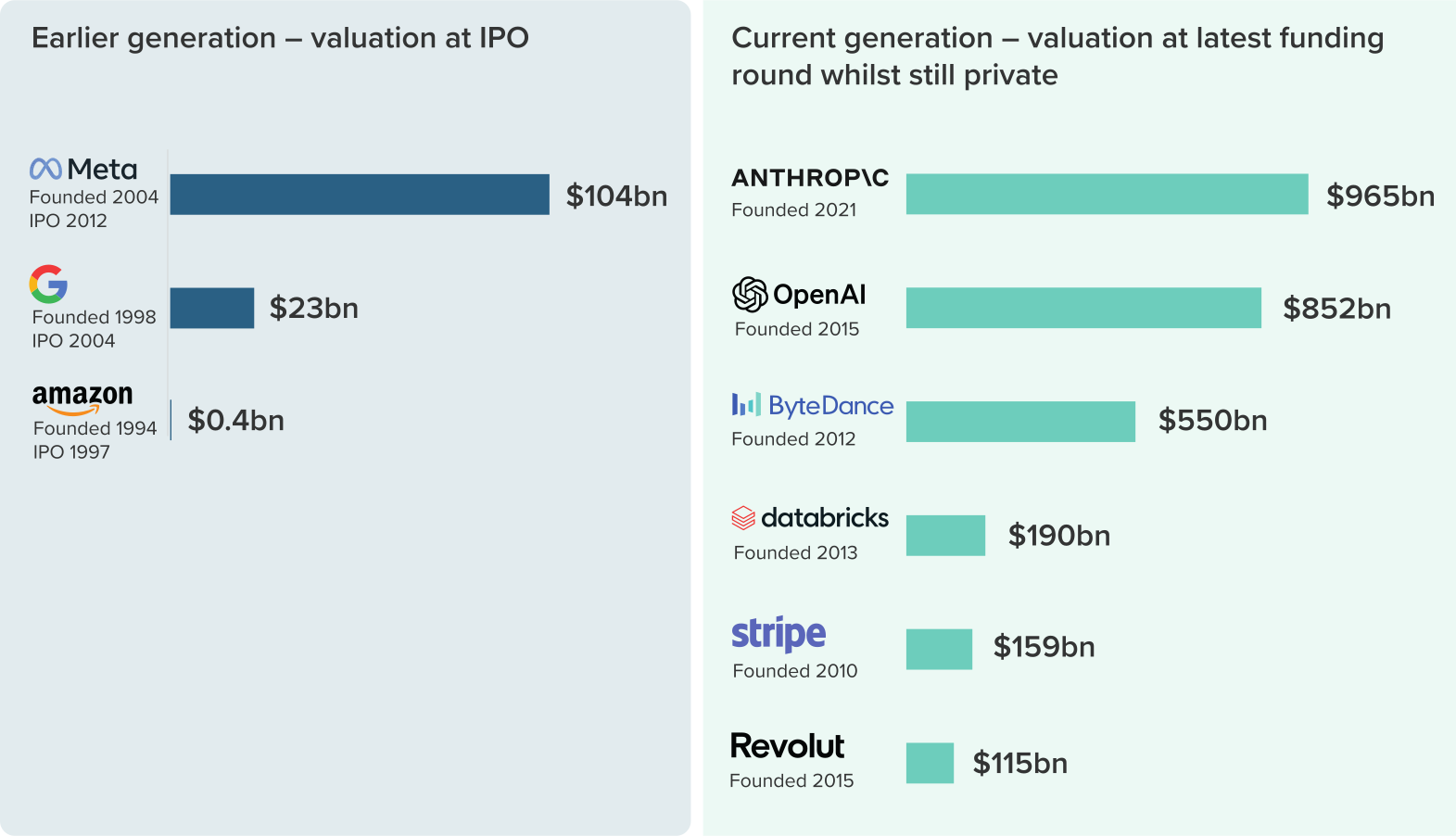
Amazon listed in 1997, three years after it was founded, at a valuation of around $438 million. Google came to the stock market six years after launch at roughly $23 billion. Facebook listed after eight years at about $104 billion.
Investors buying at those IPOs were still getting access relatively early. Amazon has since grown from less than $500 million to more than $2.7 trillion, while Google and Facebook’s parent companies have also gone on to become businesses worth well over $1 trillion.
At the time, public markets were a key source of growth capital for ambitious technology companies. Today, the availability of venture capital, growth equity, sovereign wealth and private market capital means companies can raise billions of dollars while remaining private and reaching remarkable valuations.
Public markets can deliver attractive returns. However, investors waiting for an IPO may miss a significant part of a company’s growth, while some companies may never reach the stock market at all. For investors seeking exposure to businesses at the forefront of artificial intelligence, private markets have become increasingly difficult to ignore.
It’s important to note that Private Markets investments are typically less liquid than quoted shares, valuations may be more subjective, and there is no guarantee that successful private companies will ultimately list on a public market or deliver returns. In fast-growing sectors such as AI, expectations can change quickly and valuations may prove difficult to justify if growth falls short of expectations.
| 30/09/2025 - 30/09/2026 | 30/09/2024 - 30/09/2025 | 30/09/2023 - 30/09/2024 | 30/09/2022 - 30/09/2023 | 30/09/2021 - 30/09/2022 | |
|---|---|---|---|---|---|
| Amazon |
15.0%
|
17.4%
|
33.4%
|
2.9%
|
-16.9%
|
| Alphabet |
43.8%
|
46.7%
|
15.6%
|
25.1%
|
-13.6%
|
| Meta |
0.4%
|
28.2%
|
74.0%
|
102.4%
|
-51.7%
|
Source: Morningstar, 30/09/2021 to 30/09/2026, with dividends reinvested, in GBP. The return for UK investors will be affected by currency fluctuations. Past performance is not a guide to the future.
To access this content, please enter your email address. We’ll check if you've already certified as a Sophisticated or High Net Worth Investor. If we don't recognise your email, you’ll be asked to register.
Private market funds are not the only way to gain exposure to companies such as Anthropic. A small number of investment trusts also have meaningful exposure to fast-growing private technology companies.
They can provide access to the same growth opportunity, but the investment experience is different. Because they are listed, investment trust share prices are influenced by investor sentiment and movements in discounts and premiums to net asset value.
This can make them considerably more volatile than private market funds, whose valuations are primarily based on assessments of the underlying companies. Investment trusts can also behave more like other listed equities during periods of market stress.
Investing in private markets has become much more accessible in recent years. Through the Wealth Club Private Markets Platform, you can access a broad range of funds across venture capital, growth equity, private equity, private credit and infrastructure, all managed by some of the world's leading specialist investment firms.
You can choose to invest directly into a fund or hold it within a SIPP. All three funds featured in this article are available within a SIPP (Self Invested Personal Pension).
Holding investments in a SIPP can offer significant tax advantages. You can transfer funds from most existing private pensions and SIPPs or make new contributions. When you contribute, you can benefit from tax relief of up to 45%. Investments held within a SIPP can grow free from UK income tax and capital gains tax, and you can normally withdraw up to 25% of your pension tax free at retirement, with the remainder taxed as income. Tax rules can change and benefits depend on circumstances.
Note, pension funds cannot usually be accessed before age 55 (rising to 57 in 2028), which may suit the long-term nature of private markets investing.
Because of restrictions on the promotion of private market investments, investors must qualify as either a High Net Worth Investor (HNW) or Sophisticated Investor (SI) before they can view details about individual funds. Once qualified, you can review the available opportunities and invest online through the Wealth Club Private Markets Platform.
Wealth Club aims to make it easier for experienced investors to find information on – and apply for – investments. You should base your investment decision on the offer documents and ensure you have read and fully understand them before investing. The information on this webpage is a marketing communication. It is not advice or a personal or research recommendation to buy, sell or hold any of the investments mentioned, nor does it include any opinion as to the present or future value or price of these investments. It does not satisfy legal requirements promoting investment research independence and is thus not subject to prohibitions on dealing ahead of its dissemination.
Alex Davies
Founder and CEO
Alex was a board director at Hargreaves Lansdown, where he worked for 15 years. He was responsible for building Hargreaves Lansdown into the biggest direct-to-consumer SIPP provider in the UK with more than 150,000 clients and over £12 billion under management. He is a keen investor with a portfolio of shares, funds, student property, EIS and VCT investments.