CGT raid fears – what could it mean for investors?

Don't invest unless you’re prepared to lose all the money you invest. This is a high-risk investment and you are unlikely to be protected if something goes wrong. Take 2 mins to learn more.
Estimated reading time: 2 min
Due to the potential for losses, the Financial Conduct Authority (FCA) considers this investment to be high risk.
What are the key risks?
If you are interested in learning more about how to protect yourself, visit the FCA’s website here.
Tax speculation is ramping up ahead of the 28 October Budget.
Prime Minister Andy Burnham and Chancellor John Healey are reportedly considering increasing Capital Gains Tax (CGT) to as much as 45%, to fund an increase in the personal allowance. It’s estimated this could raise, or in other words cost investors, an additional c.£20 billion by 2030.
Investors have already seen the CGT regime become markedly less favourable, with the annual exemption cut by more than 75% and rates on most investments increased to as much as 24% two years ago.
If the 2026 Budget brings further rate increases, the impact is likely to be significant.
Some may simply decide not to sell assets and hang onto them instead.
There are, however, alternatives. The government-backed Seed Enterprise Investment Scheme (SEIS) and Enterprise Investment Scheme (EIS), for instance, could help save tax while directing capital towards growing British businesses.
Investors grappling with the last CGT rate increase are increasingly turning to these schemes. SEIS offers up to 50% CGT reinvestment relief, while EIS allows investors to defer capital gains. Tax rules can change and benefits depend on circumstances.
Indeed, we have already seen a significant uptick in SEIS demand, particularly since the start of the year. That's when a large number of people filling their tax returns would have seen, in pounds and pence, the impact of the higher CGT rate introduced in the 2024 Budget. Since 1 February 2026, 45% more has been invested in SEIS through Wealth Club compared with the same period last year. Remember: investing in early-stage businesses is high risk and you should not invest for the tax benefits alone.
So, if you are affected by the existing higher rate of CGT and record-low tax-free allowance, and are concerned about potential further changes, what options do you have?
Here we explain what options are available to experienced investors, how SEIS and EIS work, their benefits and risks.
This article provides a brief outline based on current rules, which may include annual investment limits, minimum holding periods and other conditions: you should consider these carefully before investing.
Important: The information on this website is for experienced investors. It is not a personal recommendation to invest. If you’re unsure, please seek advice. These investments are for the long term. They are high risk and can fall as well as rise in value: you could lose all the money you invest.
When you invest in SEIS, you are effectively backing a basket of usually 10-25 very young and ambitious companies. Any one of them could become a household name, but statistically the risk of failure is very high.
To compensate for the significant risks – and to encourage investment – the government offers very generous tax relief:
Imagine you have a £100,000 taxable gain (£24,000 CGT liability) and a £50,000 income tax bill.
If you invest £100,000 in SEIS, you could claim up to £50,000 back in income tax and £12,000 (half of £24,000) in CGT.
This means instead of paying a total tax bill of £74,000, you have £100,000 working for you.
Moreover, that £100,000 SEIS investment could effectively cost you as little as £38,000, once you take the tax reliefs into account.
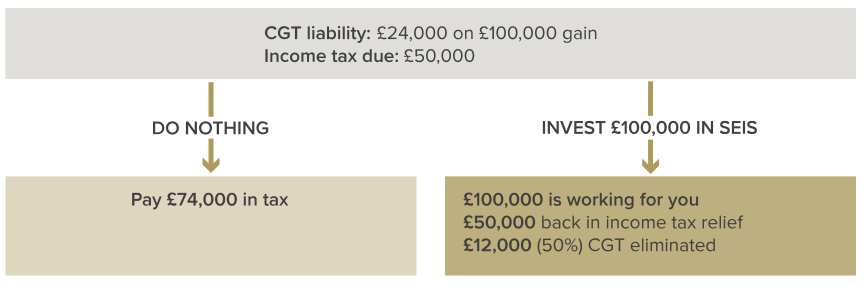 |
For illustrative purposes only. Assumes you are a higher or additional-rate taxpayer and have already used your CGT-free allowance.
Alongside the considerable risks of investing in small, young companies, please remember that to claim Reinvestment Relief you must have also claimed the income tax relief in the same tax year. So, in the above example, to claim full relief on the £24,000 CGT bill, you would first have to claim the £50,000 income tax relief in the same tax year. The maximum you can invest in SEIS with tax relief is currently £200,000.
If you don't invest the full gain, you should get CGT relief of 50% of the portion of the gain you have invested into SEIS.
You can think of the EIS as the older sibling of SEIS. It targets the same type of companies – young and ambitious – but a little further down the line, perhaps once they have started to commercialise or generate revenue. At this stage, the risk of failure is slightly lower than with SEIS but still significant.
This is reflected in the level of tax relief on offer:
Investing a gain in EIS can allow you to defer the CGT liability until you dispose of the EIS shares.
For example, if you realise a £100,000 taxable gain, you would normally face a £24,000 CGT bill. However, by investing that £100,000 into an EIS, you could defer the £24,000 CGT liability and also claim up to £30,000 in income tax relief. As a result, rather than paying £54,000 in taxes upfront, you would instead have £100,000 working for you.
When your investment is realised, the deferred CGT liability comes back into charge at the prevailing rate of CGT. It’s important to note this could be higher (as rumoured) or lower than the current rate. If you re-invest in EIS, you can continue deferring the gain, potentially indefinitely.
To qualify for deferral relief, the EIS investment must be made at least 12 months prior to, or three years after, the original gain. This is just a short summary – other rules and restrictions may apply.
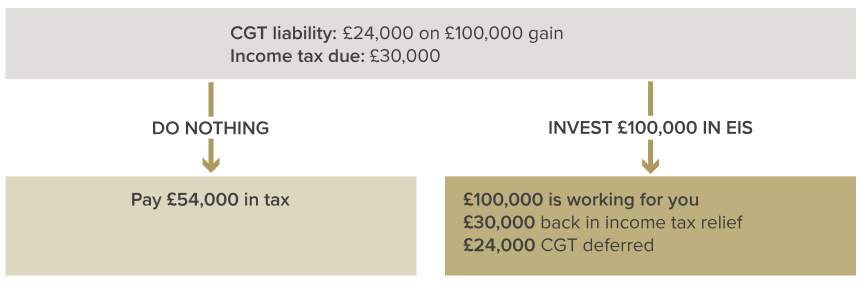 |
For illustrative purposes only. Assumes you are a higher or additional-rate taxpayer and have already used your CGT annual exempt allowance.
Alongside the considerable risks of investing in small, young companies, there are two key points to remember when deferring a gain.
First, you are deferring the gain, not eliminating it. When the EIS investment is realised, the CGT bill becomes payable, even if the investment is sold at a loss or has failed. One mitigating factor is that EIS loss relief may allow you to offset losses against either your CGT or income tax bill.
Second, as mentioned earlier, when the CGT becomes payable, it will be charged at the prevailing rate at that time, so if CGT goes up the deferred gain will be subject to this higher rate. Remember, tax rules can and do change and the value of benefits will depend on individual circumstances.
If you don't invest the full gain, you should be able to defer the CGT due on the portion of the gain you have invested.
If you are concerned about CGT, but haven't yet realised a taxable gain, you may want to consider making the most of your annual ISA and pensions allowances.
In both cases, any gains you realise within the tax wrapper should be tax-free.
You can invest up to £20,000 in an Individual Savings Account (ISA) each tax year. The annual allowance for pensions (including SIPPs or Self Invested Personal Pensions) is more complex. Most UK residents under 75 can contribute as much as they earn, capped at £60,000. Restrictions can apply for higher earners, non-earners, and those already drawing pension income. In some cases, you may be able to invest more if you have unused pension allowance from the previous three tax years (for a quick summary, you can see our free Carry Forward factsheet).
If you are reviewing where to invest your ISA or pension, Wealth Club offers the Wealth Club Portfolio Service. Or, if you are interested in adding exposure to private markets to your investment portfolio, you could consider our Private Markets SIPP.
Note: These are long-term investments that can fall as well as rise in value; returns are not guaranteed. Pensions are long-term investments: you cannot normally access your funds before age 55 (57 from 2028). Please check your eligibility before making any contributions. Private markets investments are high risk and illiquid – they are only for eligible investors.
The Wealth Club Portfolio Service, also exclusive to Wealth Club, is specifically designed to provide high net worth and sophisticated investors with a best-value, sensible long-term home for their wealth.
You can choose from five portfolios – Conservative, Balanced, Growth, Adventurous Growth and Income – we manage them for you.

Picture of Prime Minister Andy Burnham by Simon Dawson / No 10 Downing Street
Wealth Club aims to make it easier for experienced investors to find information on – and apply for – investments. You should base your investment decision on the offer documents and ensure you have read and fully understand them before investing. The information on this webpage is a marketing communication. It is not advice or a personal or research recommendation to buy, sell or hold any of the investments mentioned, nor does it include any opinion as to the present or future value or price of these investments. It does not satisfy legal requirements promoting investment research independence and is thus not subject to prohibitions on dealing ahead of its dissemination.
Susannah Streeter
Chief Investment Strategist
Susannah joined Wealth Club after five years as Head of Money and Markets at Hargreaves Lansdown. Previously, Susannah was a senior correspondent and financial news presenter at the BBC’s Economics and Business Unit, anchoring programmes on global stock markets and economic developments. She holds a first class degree from Aston University in French with Society and Government.